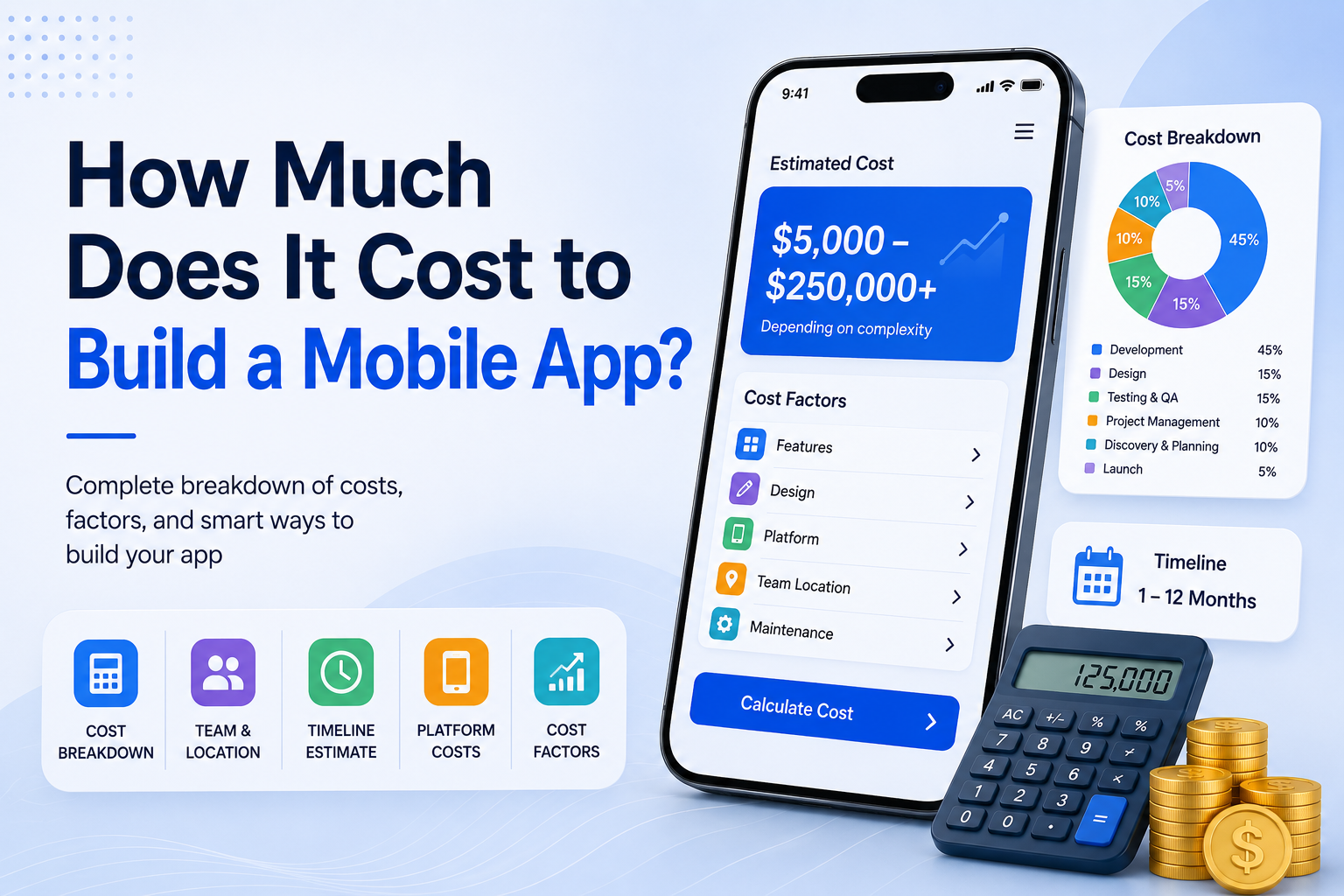
| Building a mobile app in 2026 usually costs between $5,000 and $250,000 when you hire a team. The price is driven by complexity, features, the platforms you target, and where your developers are based. The single biggest way to spend less is to skip custom code: with a no-code app CMS like AppMinCMS, you can build and manage iOS and Android apps from €29/month instead of paying for months of development. |
You have got an app idea. Maybe a really good one. And the first question that stops most people cold is the same one that brought you here: how much is this actually going to cost me?
It is a fair question with a frustrating answer, because “an app” can mean almost anything. A simple booking tool and a full-blown marketplace are both “apps,” but nobody expects them to cost the same. That is why you will see one website quote $10,000 and another quote $300,000. Both are telling the truth, they are just describing very different projects.
So instead of throwing one scary number at you, this guide breaks the whole thing down: real price ranges by app size, a proper cost breakdown by stage, what changes the total, and the hidden costs nobody puts on the quote. And because we build a mobile app platform, we will also show you exactly how a no-code approach cuts the bill and what it costs.
How much does mobile app development cost in 2026?
The honest answer is: it depends on how you build it. If you hire a team to write custom code, the mobile app development cost is mostly decided by one thing above all others, complexity. The more your app has to do, the more it costs. Here are the three tiers almost every project falls into.
Simple app: $5,000 – $25,000
Think a basic booking tool, a single-purpose utility, or an early MVP built to test an idea. A handful of screens, one platform, standard design, and little or no custom backend. This is where most first-time founders and small businesses should start, and honestly, it is the smartest place to begin.
Medium app: $25,000 – $80,000
Now you are adding user accounts, payments, a real backend, third-party integrations and a custom look. Most business apps and marketplaces live here. This is also the usual range for ecommerce mobile app development cost, since a shopping app needs a product catalog, cart, checkout and secure payments.
Complex app: $80,000 – $250,000+
Real-time features, video, AI, heavy data, tight security and a backend built to scale. Social apps, on-demand platforms and fintech sit here. Healthcare mobile app development cost also lands in this band, partly because of the engineering and partly because of the compliance and security work involved.
| App type | What it includes | Typical cost | Timeline |
| Simple app | A few screens, one platform, standard design | $5,000 – $25,000 | 1 – 3 months |
| Medium app | Accounts, payments, custom design, integrations | $25,000 – $80,000 | 3 – 6 months |
| Complex app | Real-time features, heavy backend, custom logic | $80,000 – $250,000+ | 6 – 12 months |
| No-code CMS app | Pre-built modules assembled in a platform | from €29/month | Days to weeks |
Figures are 2026 averages for custom development. Your final price depends on features, team and region.
App cost by platform: iOS, Android or both
The platforms you target change the math, because with traditional development each platform can mean a separate codebase, separate testing and separate maintenance.
- iOS only: Often a bit cheaper because Apple has fewer devices to test against.
- Android only: Android mobile app development cost can run slightly higher for the same features, since more devices and screen sizes mean more testing.
- Both, built natively: The most expensive route, because you are effectively building two apps.
- Cross-platform (Flutter, React Native): One shared codebase for both platforms. Usually cuts 30–40% versus two native builds.
Worth knowing: a no-code platform gives you both iOS and Android from a single project, so “both platforms” stops being an extra line on the invoice.
App cost by team type and location
Same app, very different invoice. Who builds your app, and where they sit, can swing the cost of mobile app development by five times or more. Developer rates are tied to geography, so identical work costs very different amounts around the world.
| Who builds it | Typical hourly rate | Mid-level app cost |
| US / Canada agency | $100 – $250 | $60,000 – $150,000 |
| UK & Western Europe | $70 – $180 | $45,000 – $120,000 |
| UAE & Middle East | $50 – $120 | $35,000 – $90,000 |
| Eastern Europe | $40 – $90 | $28,000 – $70,000 |
| India & South Asia | $20 – $50 | $15,000 – $45,000 |
| Freelancer (mixed) | $25 – $150 | $5,000 – $40,000 |
This is why the mobile app development cost in the UK or US comes in higher than the same app built in India or Eastern Europe. Lower rates do not automatically mean lower quality, vet any team on their past work, not their location.
Where the money actually goes: cost by phase
People picture app cost as “paying developers to write code.” Coding is a big chunk, but it is only one stage. Here is how a typical custom budget splits across the whole project, a genuinely useful mobile app development cost breakdown.
| Phase | Share of budget | What it covers |
| Discovery & planning | 10% | Defining the app, user stories, early prototypes |
| UI / UX design | 15% | Screens, flow, wireframes, prototype |
| Development | 45% | Frontend, backend and integrations |
| Testing & QA | 15% | Finding and fixing bugs across devices |
| Launch | 5% | App Store and Google Play submission |
| Project management | 10% | Planning, coordination, status updates |
Skipping the discovery phase is the single most expensive mistake founders make. Vague requirements lead to expensive rebuilds later. A clear plan up front is the cheapest insurance you can buy.
Cost by app category
- Ecommerce app: catalog, cart, checkout and payments. Usually $30,000 – $100,000.
- On-demand app (rides, food, services): live tracking and two-sided users. Often $50,000 – $150,000.
- Healthcare app: data security and compliance push it higher, typically $60,000 – $200,000.
- Social app: feeds, messaging, media and scale. Commonly $80,000 – $250,000.
- Mobile game: the mobile game app development cost ranges from about $10,000 for a simple 2D game to $250,000+ for polished 3D titles.
- Business / internal app: dashboards, forms and data. Usually $20,000 – $80,000.
The kind of app you are building matters too, because different categories need different features.
The hidden costs nobody puts on the quote
Most quotes focus on the upfront build and quietly leave out the running costs. These are the ones that surprise people after launch.
- Maintenance: usually 15–20% of the build cost every year. A $50,000 app quietly costs $7,500 – $10,000 a year to keep alive.
- App store fees: Apple charges $99/year and Google Play a one-time $25 to publish.
- Third-party services: maps, payment gateways, chat and AI models often charge per use, and those fees add up.
- Security & compliance: meeting standards like GDPR adds planning and review work, and retrofitting it later costs more than building it in.
| Do not forget year two An app is not a one-time purchase. If you budget 15–20% of the build cost a year for upkeep, a $100,000 app is really a $118,000 – $130,000 first-year commitment. A platform that handles hosting, updates and security for you removes most of that line item. |
How AppMinCMS cuts your app cost ?
The biggest lever for reducing mobile app costs is not finding a cheaper developer, it is skipping custom development where you do not need it. AppMinCMS is a mobile app CMS that lets you build and manage iOS and Android apps without writing a single line of code.
Instead of paying a team to build things that already exist, you assemble ready-made modules, login, payments, notifications, catalogs, bookings, content, in one dashboard, and publish to both app stores. Then you update your app any time, without hiring anyone or waiting for a developer sprint. The savings show up in a few clear places.
- No development team to pay. The single largest line on a custom quote simply disappears.
- Both platforms included. iOS and Android come from one project, so you are not paying twice.
- Hosting and updates handled. The platform takes care of infrastructure, so ongoing costs stop being a mystery.
- Change it yourself. Editing content or swapping a screen is a few clicks, not a paid change request.
Other ways to reduce app development cost
Whether you go custom or no-code, these habits keep the budget lean without hurting the result.
- Start with an MVP. Build the one feature that solves a real problem, launch it, and add the rest once people actually use it.
- Use cross-platform or no-code. One project for both platforms beats maintaining two separate builds.
- Prioritise features ruthlessly. If removing a feature would not break the core task, it is a nice-to-have. Launch without it.
- Reuse solved problems. Payments, chat, login and analytics already exist. Do not pay to rebuild them.
- Write a clear brief. The more precise you are up front, the fewer costly changes you pay for later.
How much does it cost to build an app with AppMinCMS?
This is where the numbers get friendly. Compared to a custom build, AppMinCMS is a completely different kind of cost. There is no large upfront project fee and no hourly rate ticking every time you want a change. You pay one simple monthly subscription, and everything you need to build, publish and manage your app is included.
| What you get | Custom development | AppMinCMS |
| Upfront build cost | $5,000 – $250,000 | $0 |
| iOS + Android + web | Often billed separately | Both included |
| Time to launch | 1 – 12 months | Days to weeks |
| Ongoing cost | 15 – 20% of build / year | from €29 / month |
| Making changes | Paid change requests | Do it yourself |
| Simple, predictable pricing AppMinCMS starts at €29 per month, which covers building and managing your iOS and Android app from one dashboard, with hosting and updates included. You can explore and set your app up before you commit, and there are no surprise bills, no per-change fees, and no separate charge for each platform. Put another way: instead of a €50,000 quote and a six-month wait, you are looking at a monthly subscription and an app you can launch this month. |
When custom development still makes sense ?
No-code is not the answer for every single project, and it is worth being straight about that. Custom development is the better fit when you need deep, unusual engineering: specialised hardware integrations, uncommon sensors, heavy real-time systems, or compliance requirements that go beyond what a platform supports. If you already have an in-house engineering team and a familiar stack, building with them can also make sense.
For almost everything else, an ecommerce app, a booking app, a content app, an internal tool, a community app, a no-code CMS gets you there faster and for a fraction of the price.
How to estimate your own app cost
Want a quick number before you talk to anyone? Here is a simple way to estimate mobile app development cost in five minutes.
- Pick your base app size (simple, medium or complex) and take its starting figure from the table above.
- Add the extra features you need, using the phase and category sections as a guide.
- Decide on one platform or both, and adjust up if you need both built natively.
- Choose your team type and apply the regional rate that fits.
- Add 15–20% of the total as a yearly maintenance budget.
That gives you a realistic ballpark to walk into any quote with. And if the number feels high for what you actually need, that is usually the sign to look at a no-code route before committing to a full custom build.
Frequently asked questions
How much does it cost to build a simple mobile app?
A simple mobile app typically costs $5,000 to $25,000 with a custom team, covering a few screens, one platform and standard design. With a no-code CMS like AppMinCMS, you can build a simple app from $24/month and skip the upfront fee entirely.
Why do mobile app development cost estimates vary so much?
Because “an app” can mean almost anything. Price depends on complexity, features, design, platforms, who builds it and where they are based. Two apps that sound identical can cost ten times apart once you look at what is actually inside them.
Is it cheaper to build for Android or iOS?
Building each individually is roughly similar. The real savings come from cross-platform or no-code tools that produce both from one project, which is far cheaper than building two native apps separately.
How much does app maintenance cost per year?
With custom development, a common rule of thumb is 15–20% of the build cost per year for hosting, updates and bug fixes. On a platform like AppMinCMS, hosting and updates are handled for you, so your ongoing cost is largely just the monthly subscription.
Can I build an app without hiring developers?
Yes. No-code platforms let you build and manage iOS and Android apps from a single dashboard using pre-built modules. It is the fastest and most affordable route for most businesses that do not need heavily custom engineering.
What is a realistic budget for a first app?
If you are testing an idea, keep it lean: build the core feature only, launch, and learn. With custom development that might be $5,000–$25,000. With AppMinCMS you can start from $24/month, which makes it a far more accessible option for bootstrapped founders.
Skip the six-figure quote
Build and manage your mobile app with AppMinCMS, no code, no long timelines, and no surprise bills. Just a CMS-style workflow that gets you to launch fast, starting at $24/month.