If you run an agency, sooner or later a client will ask for a mobile app.
It may be a restaurant that wants online ordering, loyalty rewards, and push notifications. It may be a salon that wants appointments and offers. It may be a local service business that wants forms, galleries, service pages, and customer updates.
At that point, your agency has two main options.
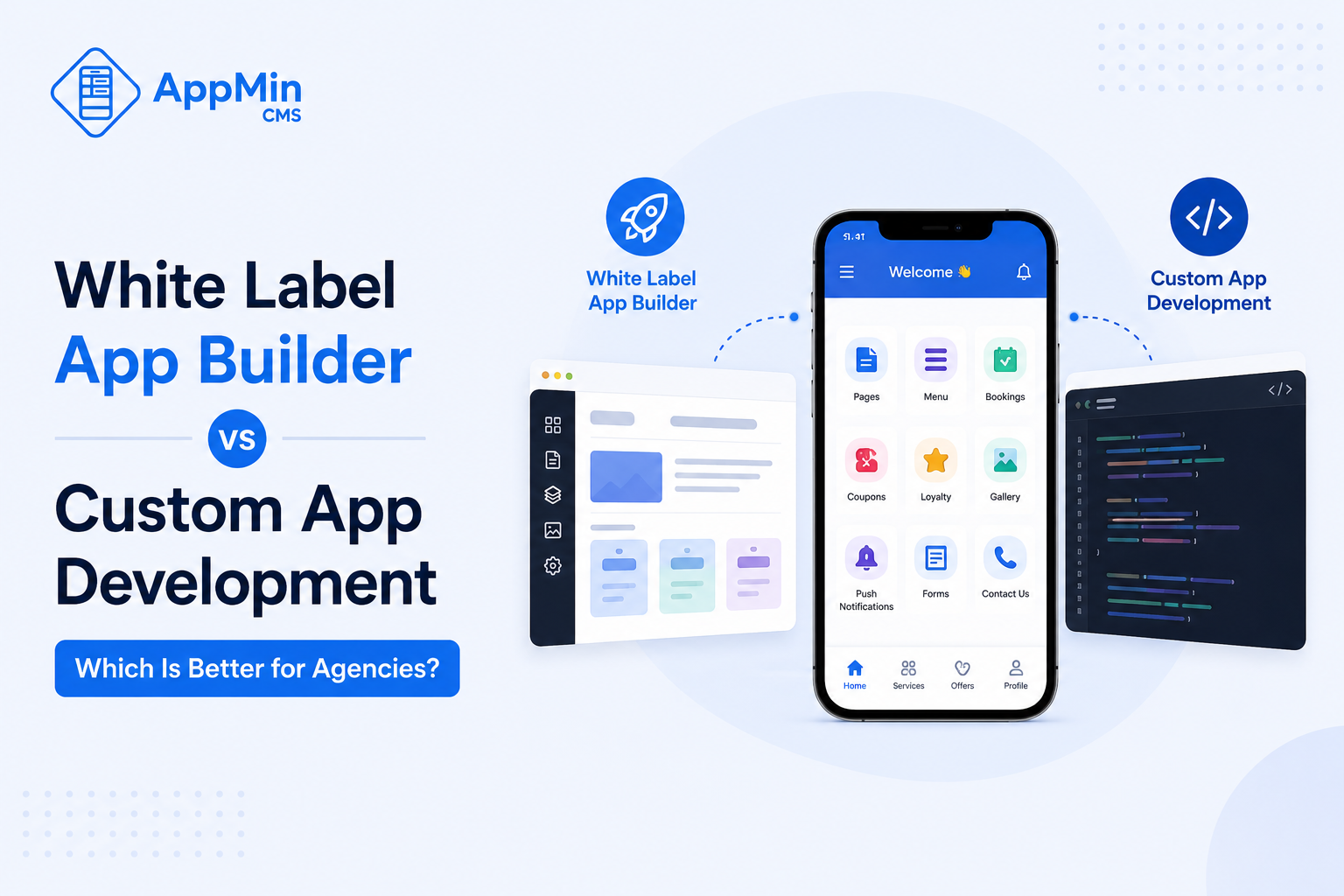
You can build the app from scratch with custom development, or you can use a white label app builder and deliver the app under your own brand.
Both options can work. The right choice depends on the type of clients you serve, your budget, your delivery model, and whether you want to sell apps once or build recurring revenue from multiple client apps.
After working for years around mobile app builders, custom modules, client app projects, and agency-style delivery, one thing becomes clear: most agencies do not struggle only because they cannot build one app. They struggle because they cannot repeat the process profitably for many clients.
That is where the difference between custom development and white-label app building becomes important.
Explore AppMinCMS White-Label Mobile App Builder.
What is a white label app builder?
A white label app builder is a platform that allows agencies, freelancers, resellers, and software companies to create mobile apps for clients under their own brand.
The platform provides the technical foundation. You use its dashboard, modules, layouts, templates, branding options, app preview, and publishing workflow to create apps faster. The client sees your brand, your service, and their app. The builder works behind the scenes.
For an agency, this means you can sell mobile apps without hiring a full iOS and Android development team for every client project.
The main value is repeatability. You are not starting from zero every time. You are using a platform to create client apps faster, then charging for setup, support, updates, and monthly app management.
What is custom app development?
Custom app development means building a mobile app from scratch using designers, backend developers, mobile developers, APIs, databases, and custom code.
This gives you maximum flexibility. You can build almost anything if the budget, timeline, and technical team are available.
Custom development is usually the better choice when the app needs unique business logic, advanced backend workflows, complex user roles, deep integrations, or a completely custom product experience.
But custom development is also slower and more expensive.
For agencies selling apps to local businesses, this can become a problem. A restaurant, salon, gym, clinic, or local service business may not need a fully custom product. They usually need a branded mobile app with practical features like booking, coupons, loyalty, forms, gallery, push notifications, pages, menus, catalog, or e-commerce-style modules.
In those cases, custom development may be more than the client actually needs.
The real question agencies should ask
The question is not only:
“Which option is more powerful?”
Custom development will always be more flexible.
The better question is:
“Which option helps my agency deliver profitable client apps repeatedly?”
If your goal is to build one complex product, custom development may be right.
If your goal is to sell mobile apps to many local businesses, a white label app builder can be more practical.
White label app builder vs custom development
Here is the simple difference.
A white label app builder is built for speed, repeatability, branding, and app delivery at scale. It works well when you want to create many business apps using reusable modules, templates, and layouts.
Custom development is built for full control. It works well when the client needs a unique product, special workflows, or advanced backend logic that cannot be handled by a ready-made platform.
| Area | White Label App Builder | Custom App Development |
|---|---|---|
| Best for | Agencies, resellers, local business apps, repeatable app packages | Unique products, SaaS apps, complex workflows |
| Speed | Faster because modules and templates already exist | Slower because everything is planned and built manually |
| Cost | Lower setup cost per client app | Higher development cost |
| Flexibility | Limited to platform modules and customization options | Maximum flexibility |
| Maintenance | Core platform is managed by the provider | Your team manages maintenance and updates |
| Scaling | Easier for agencies managing many apps | Harder unless you build a full technical team |
| Revenue model | Good for setup fee plus monthly app management | Usually project-based unless you add retainers |
The short version is simple.
Custom development gives control.
White-label app builders give speed, repeatability, and a better reseller model.
When a white label app builder is the better choice?
A white label app builder is usually better when your agency wants to create client apps as a repeatable service.
For example, an agency may want to sell apps to restaurants, cafés, salons, clinics, gyms, schools, communities, consultants, events, or local service businesses.
These clients usually do not want to spend months building a custom app. They want a useful branded app that helps them communicate with customers, collect bookings, send offers, manage content, and improve retention.
A restaurant app may need a menu, booking, gallery, coupons, loyalty, push notifications, and contact details. A salon app may need services, staff profiles, appointments, offers, loyalty, gallery, and reminders. A clinic app may need appointment requests, forms, patient information pages, push notifications, and location details.
These are real business needs, but they do not always require custom development from zero.
When custom development is the better choice?
Custom app development is better when the app itself is the business.
If the client is building a SaaS product, marketplace, delivery platform, fintech app, healthcare platform, social network, or advanced internal system, then a white label builder may not be enough.
In these cases, the client may need custom backend logic, advanced database structure, custom APIs, strict security requirements, special user roles, or a completely unique mobile experience.
A good agency should be honest about this.
White label works best when the client needs a business app.
Custom development works best when the client needs a custom product.
This honesty is important because it helps you sell the right solution instead of forcing every client into the same model.
The agency problem: one app is easy, many apps are hard
Building one custom app is possible. Building and maintaining 30 custom client apps is a different story.
Every client will ask for small updates, content changes, new offers, push campaigns, design edits, support, publishing help, and future improvements. If every app has a separate custom codebase, support becomes difficult very quickly.
A white label mobile app builder helps because it gives your agency one platform, one workflow, and reusable modules. You can create different apps for different clients, but the operational structure stays consistent.
This is why white-label app builders are attractive for agencies and resellers. They are not only a development shortcut. They are an operational model.
Planning to sell apps to clients? Explore the App Reseller Program.
What to check before choosing a white label app builder?
Do not choose a platform only because it says “no-code” or “white label.” Most platforms use the same marketing language.
The real differences appear when you start managing multiple client apps.
First, check how deep the white-label setup is. Some platforms only allow branding inside the app. Others also support branded dashboards, client access, custom domains, reseller workflows, and agency-level management.
Second, check whether the platform supports multiple client apps. A reseller model only works if you can manage more than one client without creating operational chaos.
Third, check the module library. The platform should support practical business use cases like booking, coupons, loyalty, forms, galleries, custom pages, e-commerce or catalog workflows, push notifications, events, media, and other app features.
Fourth, check the publishing workflow. You need to understand who handles Apple and Google developer accounts, who prepares the app listing, who submits the app, and who handles app rejection or future updates.
Finally, check how pricing scales. A cheap plan can become expensive if every app, user, feature, build, or push notification is limited. A higher plan may make sense if it includes multiple client apps, white-label features, reseller tools, better limits, and support.
Pricing snapshot: what public reseller plans show
Pricing changes often, so always verify live pricing before choosing any platform. Public pricing pages are useful as a market benchmark, but they should not be treated as permanent.
Here is a simple snapshot based on public pricing pages reviewed in June 2026.
| Platform | Public pricing signal | Notes |
|---|---|---|
| AppMinCMS | Pro from €149/month billed yearly, or €179/month billed monthly. | Built for agencies and resellers with full white-label, a reseller dashboard, API access, and modern integrations like n8n, GoHighLevel, and Make, plus storage, push notifications, and support for multiple client apps |
| AppMachine | Agency plan at $159/month | Includes a limited number of apps and white-label Client CMS |
| GoodBarber | Reseller Content from €215/month billed yearly; Content + eCommerce from €290/month billed yearly | Strong reseller positioning with white-label service, custom branding, reseller interface, and app management |
| AppMySite | Agency white-label from $999/month, or $799/month paid yearly | Focused on agency white-label with unlimited customers, apps, team members, builds, and users |
| BuildFire | Standard, Growth, and Scale plans listed publicly; reseller details require demo | Public pricing is app-plan focused, with separate reseller positioning for selling apps under your own brand |
There are also app store account costs to consider. Apple Developer Program membership and Google Play Console registration are separate from most app builder subscriptions.
The lesson is not to choose the cheapest platform. The lesson is to compare the full business model.
A reseller plan should be judged by how many apps you can manage, how deep the white-label setup is, what modules are included, how publishing works, what usage limits apply, and how fast you can deliver apps to paying clients.
Example reseller pricing model
Let’s make this practical.
Suppose an agency sells local business apps with a setup fee and a monthly support plan.
For example, an agency may charge $499 as a setup fee and $79/month for support, app management, content updates, or basic maintenance.
If the agency reaches 20 clients, the monthly recurring revenue would be $1,580 before platform cost, support time, taxes, and other expenses.
This is only an example, not a guarantee. Real pricing depends on your country, client type, support level, and the value your agency provides.
But the point is clear: the business becomes interesting when you can repeat the delivery process without rebuilding every app from scratch.
That is why the platform matters.
How agencies can package mobile apps for clients?
A strong reseller offer should not simply say:
“We build apps.”
That sounds too broad.
A better approach is to create clear app packages by business type.
For restaurants, the offer may focus on menus, offers, loyalty, bookings, gallery, contact details, and push notifications. For salons, the offer may focus on services, appointments, staff profiles, offers, loyalty, and reminders. For clinics, the offer may focus on appointment requests, forms, service pages, patient information, and location details.
This makes the service easier to understand and easier to sell.
Clients do not buy “mobile app technology.” They buy outcomes. They want more bookings, better communication, repeat customers, easier updates, and stronger brand presence.
Where AppMinCMS fits ?
AppMinCMS is built for businesses, agencies, freelancers, and resellers that want to create and manage mobile apps using a no-code, CMS-style workflow.
Instead of building every app from zero, agencies can use modules, layouts, templates, app pages, media, branding, live preview, Android and iOS workflows, reseller dashboard, white-label options, and API access on eligible plans.
The AppMinCMS Pro plan is positioned for agencies and resellers, with support for managing multiple client apps, full platform white-label, custom brand settings, team and client access, reseller dashboard, API access, storage, and push notification capacity.
This makes AppMinCMS different from a simple one-app builder. The goal is to support agencies that want to turn app creation into a repeatable service.
It is also important to be clear about fit.
AppMinCMS is best suited for agencies and resellers building business apps from modules and templates. If a client needs a fully custom SaaS product, marketplace, fintech platform, or advanced backend system, custom development may still be the better choice.
For many local business apps, service apps, booking apps, content apps, and reseller workflows, a white-label app builder can be faster and more practical.
Which option should your agency choose?
Choose a white label app builder if you want to sell apps to many clients, serve local businesses, create monthly recurring revenue, and avoid building every app from scratch.
This is usually the better path when your apps can be built with modules, templates, layouts, branding, and a repeatable workflow.
Choose custom development if the client needs complex logic, advanced backend workflows, a unique product, or full technical control.
For most agencies entering the mobile app market, the smarter starting point is usually white label. You can always offer custom development later for bigger or more unique projects.
Final thoughts
The mobile app opportunity for agencies is real, but the delivery model matters.
If you try to build every client app from scratch, the work can quickly become expensive, slow, and hard to maintain.
If you use a white label app builder, you can create branded apps faster, reuse modules, manage client apps from one platform, and build monthly recurring revenue around support and app management.
The best approach is not to blindly choose the cheapest tool or the most famous platform.
Choose the platform that matches your agency model.
Look at white-label depth, number of client apps, module library, publishing workflow, support, app output, pricing scale, and client management.
If your goal is to build and resell branded iOS and Android apps for local businesses, AppMinCMS is worth considering as a white-label mobile app builder for agencies and resellers.
FAQ
What is a white label app builder?
A white label app builder is a platform that lets agencies and resellers create mobile apps for clients under their own brand, without building every app from scratch.
Is a white label app builder better than custom development?
It depends on the project. A white label app builder is usually better for repeatable local business apps, agency packages, and reseller models. Custom development is better for unique products, complex backend systems, and advanced custom requirements.
Can agencies resell apps under their own brand?
Yes. That is the core purpose of a white-label app builder or app reseller program. Agencies can build apps for clients, apply client branding, and sell app setup, support, and monthly management under their own business.
How much does a white label app builder cost?
Pricing varies by platform. Public agency and reseller plans can range from lower monthly plans to higher agency-level subscriptions, depending on the number of apps, white-label depth, storage, push notifications, support, and app management features.
Do clients need Apple and Google developer accounts?
It depends on the platform and publishing model. Some workflows require the client or agency to manage developer accounts. Apple and Google developer account costs are usually separate from the app builder subscription.
Can I build mobile apps without coding?
Yes. No-code and white-label app builders allow agencies to create apps using modules, templates, layouts, branding tools, and app preview workflows without writing code.
What kind of apps can agencies sell?
Agencies can sell apps for restaurants, salons, clinics, gyms, events, local businesses, content creators, service businesses, and other clients that need branded mobile apps with practical features like booking, coupons, loyalty, forms, galleries, and push notifications.
Is AppMinCMS only for resellers?
No. AppMinCMS can be used by business owners, agencies, freelancers, and resellers. The reseller and white-label features are mainly useful for agencies that want to manage multiple client apps and sell apps as a service.